


Test K
Test K - a test for the rapid and accurate determination of the potassium concentration in aquarium water.
Effective growth and a beautiful plant species is possible only with a sufficient concentration of potassium in water. The lack of potassium stops the growth of plants, and also causes the destruction of leaves. Excess potassium leads to the blocking of calcium and ammonium nitrogen consumption, which can lead to the appearance of unwanted algae.
Recommended concentration of potassium in aquariums with plants: 8-17 mg / l.
Before use, read the detailed instructions!
INSTRUCTION:
1. Rinse the measuring bottle with the test water.
2. Using a syringe, collect 5 ml of water and add it to a measuring bottle.
3. Add 5 drops of reagent # 1.
4. Stir for 15 seconds.
5. Add one blade without reagent slide No. 2.
6. Intense for 15 seconds and wait 5 minutes.
7. After 5 minutes of waiting, shake the solution for 5 seconds and immediately go to the measurement.
8. Go to the comparative scale.
Immediately after measuring potassium content, thoroughly wash the measuring vial.
Avoid indicator solution or water after testing getting into aquarium!
In order to get accurate measurements, the temperature of water that is to be tested must be 25±3°С, and room temperature must not be below 20°С.
Storage life: 24 months, but no more than 12 months since opening.
Keep at 10-25°С in dry dark place! Keep out of reach of childrenі!
Avoid skin contact! Upon skin contact wash with large amounts of water!


Instructions for working with the comparative scale.
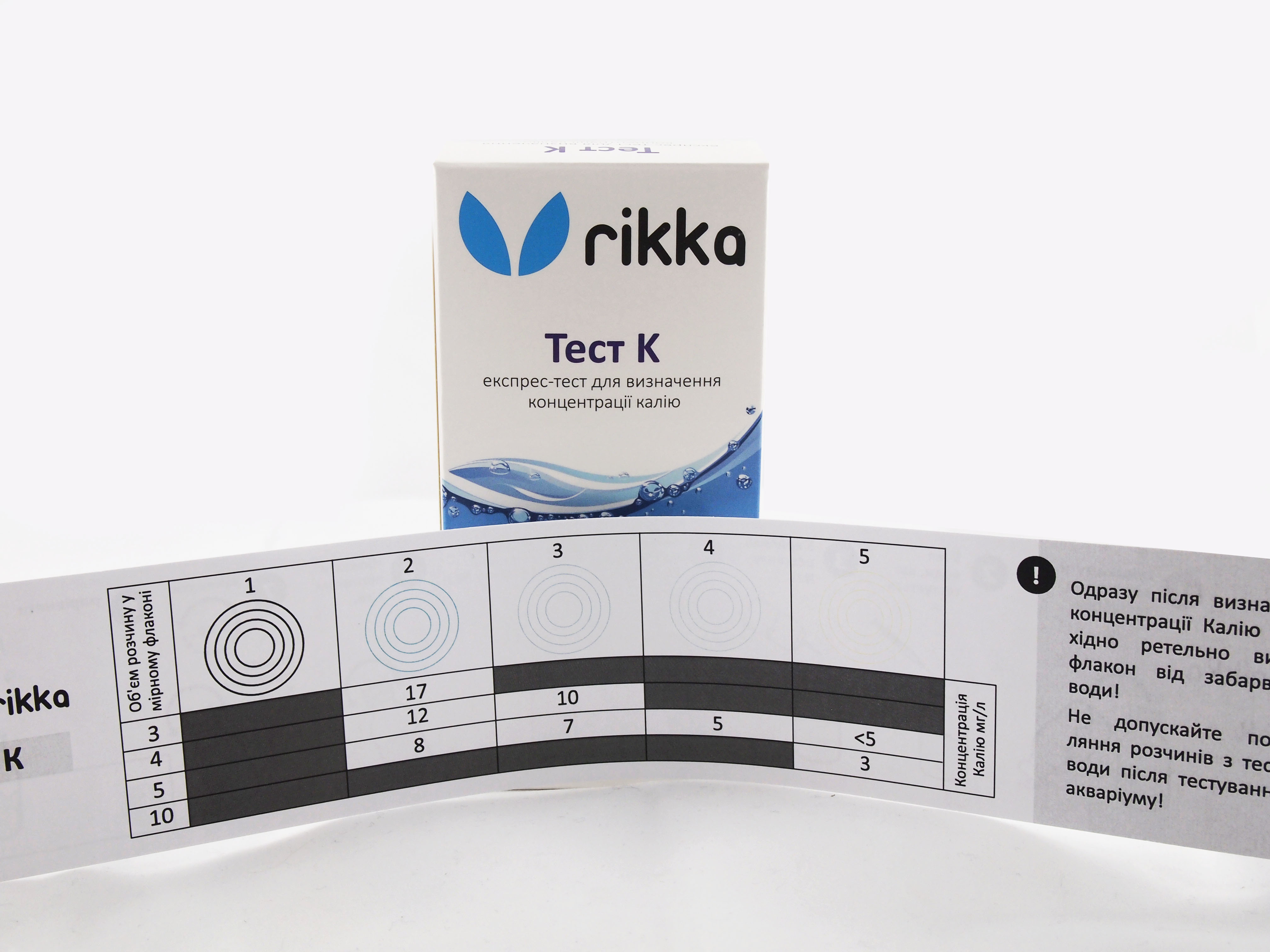
A comparative scale is a table in which:
the name of the lines "Volume in the bottle" is the volume of water in the bottle at the time of measurement;
the columns are indicated by the numbers 1-5, in order to which concentric circles of different color and saturation correspond;
at the crossroads of the column and line is the concentration of potassium in water, mg / l.
Operating procedure:
1. After carrying out operations 1.1-1.8, place the vial on the circle number 1. Open the lid and align the bottle so that it occupies the entire area of the circle. To look it is necessary vertically from above through a layer of a liquid on a chain.
It is inadmissible that direct rays of light (solar or from a lamp) fall on a bottle or a scale!
2. If you see concentric circles # 1 when looking at the top (you can clearly see that all circles are clearly visible, and if you see vague circles or only the central circle is visible), then the bottle should be moved one circle to the right (from No. 1 to No. 2 and further from №2 to №3, from №3 to №4, from №4 to №5), so it is necessary to do until the image of the circles disappears. For example: "Circle number 1 can be seen, circle number 2 can be seen, circle number 3 - is not visible - column with circle number 3 is such that it is necessary to determine the concentration of potassium."
3. After determining the column on which you can not see the circle - you must select the line that corresponds to the volume of liquid in the measuring bottle at the time of determination and at the intersection of the column and the line indicates the concentration of potassium that is currently in the aquarium.
4. If, while moving the vial from Column # 1 to No. 5, all circles are visible through the liquid layer, then the potassium concentration is less than 5 mg / l. For a more accurate determination, you can add another 5 ml of test water to repeat the procedure 1.6-1.8, and place the vial on the circle # 4 and move it to circle # 5, if the circle # 5 is visible - the concentration of potassium is less than 3 mg / l.
5. If the bottle is placed on the circle number 1 - it is not visible, then the concentration of potassium is more than 8 mg / l. For a more accurate determination, it is necessary to take 1 ml of liquid from the vial by means of a syringe (meaning - after testing, operations 1.1-1.8), and again to repeat the comparative operations 2.1-2.3 from circle # 1 to circle # 3.
In order to determine the concentration, you must use line number 4! After all, there are 4 ml left in the vial!
6. If after selection 1 ml of liquid from the measuring vial of circle №1 is still not visible - it is necessary to select another 1 ml (that is, 3 ml of liquid should remain in the vial) and repeat the comparative operations.
To determine the concentration, use line # 3!


